Every acquisition analysis starts the same way: two weeks of modeling against projections you didn't build, against a baseline that isn't yours. Arcvue has your actual operating baseline. The deal terms are the only new inputs. The analysis is done the same afternoon the CIM arrives.
A target comes across your desk. The first question—what does the combined entity look like and can you finance it—should take an afternoon. Instead it takes two weeks. An analyst builds the model from the CIM. The projections are the target's management projections, which you don't fully trust. Your baseline is whatever you last updated your internal model to. By the time the analysis is done, the process has moved, your price expectation is stale, or you've spent two weeks on a deal that was never going to work at the ask.
The post-close integration adds another layer. You planned for a six-month ERP migration. It took fourteen months, cost more than budgeted, and still didn't produce a clean consolidated view because GovCon subsidiaries can't be dissolved into the parent—they have their own contracts, their own past performance, their own clearances, their own legal identity. The entity has to stay. So both entities end up on their own books indefinitely, and someone reconciles two sets of financials in Excel every month for years.
The earnout you negotiated made sense at the time. In year two, the payment comes due at exactly the moment the business needs cash for reinvestment. Nobody modeled the cash obligation against the actual capital structure at the time of payment. It was a negotiated number, not an analyzed one.
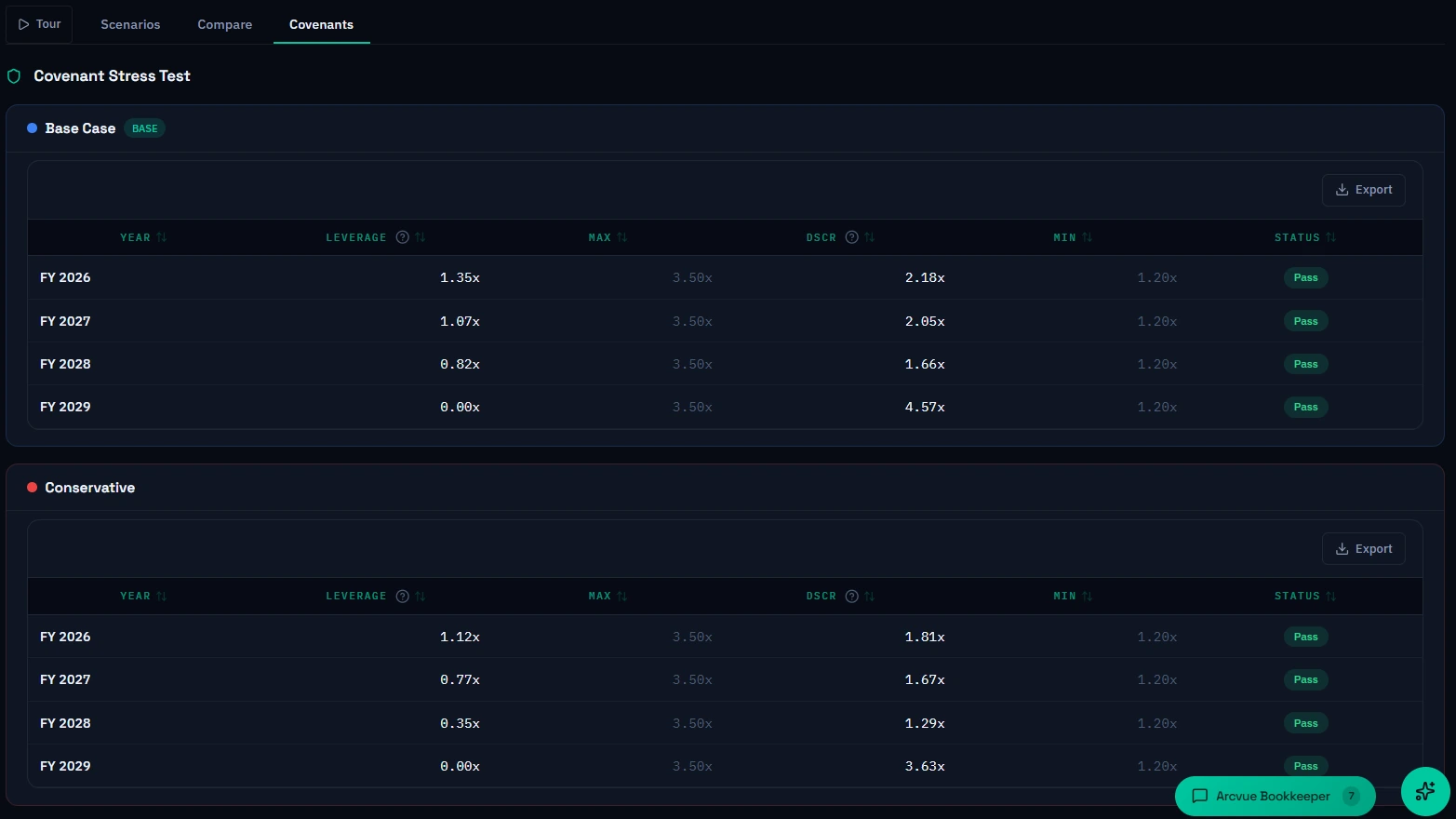
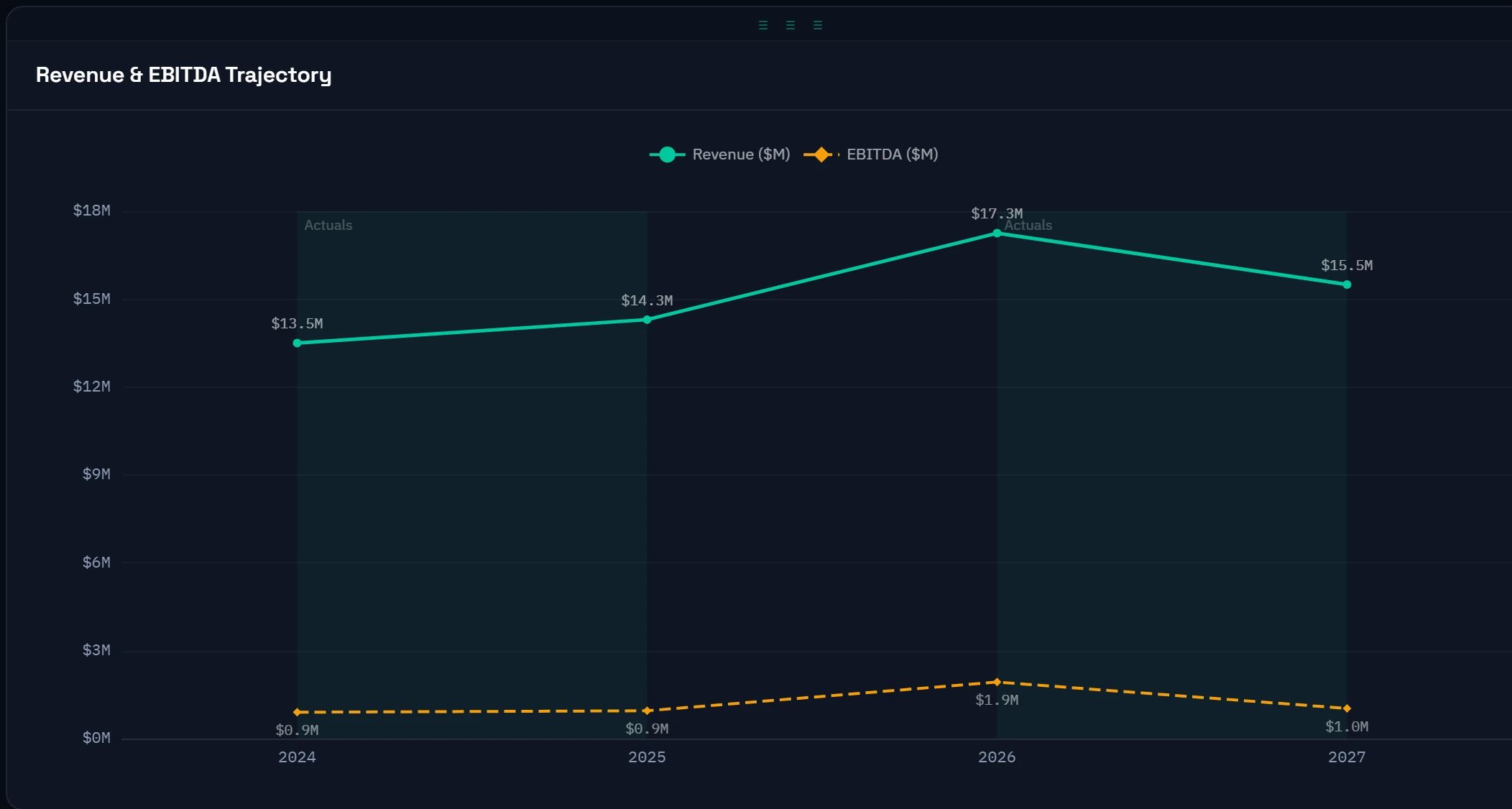
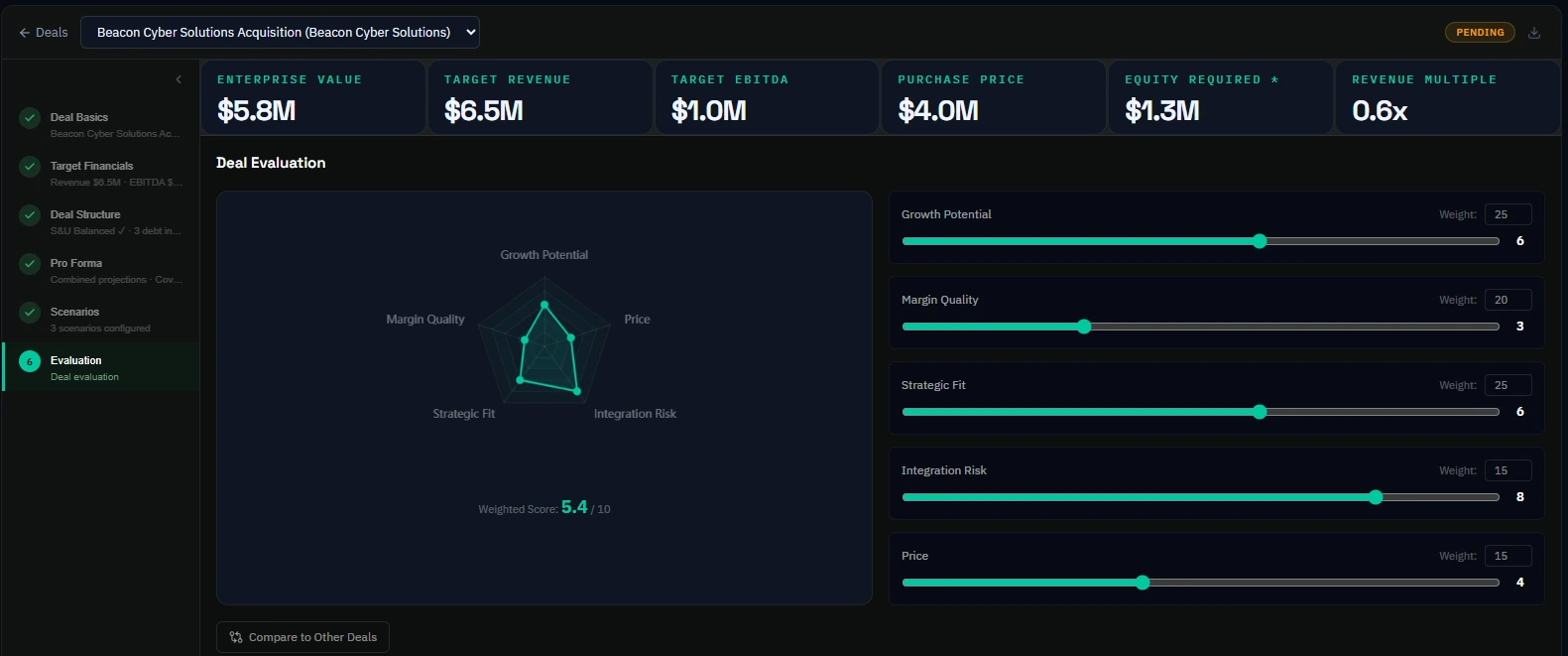
Arcvue has your actual operating baseline—last night's P&L, this morning's indirect rates, your current debt schedule and covenant thresholds. Enter the target's revenue, EBITDA, and purchase price. Select a debt structure. The platform computes sources and uses, post-close three-statement projections, covenant compliance under the combined debt load, and equity return at exit—all against your real numbers, not a generic model built from scratch for this deal.
The combined entity's indirect rate structure reflects both companies' actual cost pools. The covenant projections use your real debt schedule and your actual credit agreement thresholds—not benchmarks. The post-close cash flow projection accounts for your actual debt service, your actual LOC behavior, and the target's actual burn rate. The analysis you get isn't an approximation. It's your real financial position with the deal terms layered on top.
When the seller asks where you are, you have an answer. When your banker asks if the deal is financeable, you know before the conversation starts. The two weeks of preparation time collapses into an afternoon because the preparation was done the day you connected your ERP—not the day the deal arrived.
An earnout isn't a purchase price number. It's a future cash obligation that competes with every other use of that money—hiring, BD investment, working capital, debt service, and reinvestment into the combined business. Setting the threshold correctly requires understanding not just whether the business is likely to hit it, but what paying it does to your cash position and capital structure at the moment it comes due.
The Arcvue earnout sensitivity matrix shows nine rows: the negotiated threshold plus or minus four steps at configurable intervals. Each row shows the payout across three scenarios—downside, base, and upside—alongside a cash flow impact panel for the year the payment occurs. You see exactly how much cash the payment consumes, how much remains available for reinvestment, and what the effective purchase price looks like at each performance level. The threshold-setting conversation becomes concrete: at what level does the earnout payment compete destructively with other uses of capital?
For deals with debt in the structure, every cell is also tested against your post-close covenant thresholds in real time. Leverage and FCCR are computed at the time of payment for each scenario. When a threshold and scenario combination would breach a covenant, the cell flags automatically—before you sign the purchase agreement, not after the payment comes due. The negotiation is informed by the actual downstream consequences, not by a number negotiated in isolation.
GovCon acquisitions are almost always stock purchases. The acquired company becomes a wholly owned subsidiary but retains its own contracts, its own past performance, its own security clearances, and its own legal identity. Contract novation requires the government's agreement—which takes months and may not be granted. The entity has to stay. So the ERP integration that was supposed to solve the consolidation problem was always going to fall short, because even getting both entities onto the same platform doesn't give you a clean consolidated view when both entities remain legally separate.
Arcvue doesn't require ERP consolidation—or even the same ERP platform. The parent connects independently. The subsidiary connects independently. Each ERP syncs on its own schedule through its own adapter. A normalization engine translates both data streams into a common schema. Intercompany transactions—management fees, due-to and due-from balances, intercompany revenue—are identified and eliminated automatically every night. The consolidated P&L, balance sheet, and covenant metrics are available the morning after onboarding. Not month fourteen. The morning after.
Indirect rates are computed for each entity separately and for the combined cost structure. When you're pricing a contract that will be performed by the subsidiary but supported by parent shared services, the loaded rate reflects actual economics—not an estimate. The combined entity is visible, measurable, and manageable from day one of ownership.
Arcvue generates a complete bank-ready lender model in a single click. Cover tab with deal summary and company overview. Historical P&L from your actual ERP actuals—not reconstructed from management estimates. Five-year projection model with full post-close income statement, cash flow waterfall, and debt schedule with amortization by instrument. Covenant analysis showing DSCR and leverage against your actual credit agreement thresholds year by year. Cap table at close and at exit. GovCon-specific credit metrics that general-purpose models never include: funded backlog coverage, contract concentration analysis, indirect rate history and trend, and a revenue waterfall decomposing active contracts, recompetes, and new growth.
The workbook is built to investment banking standards—the format your banker presents and your credit committee already knows how to read. When the credit committee opens it, the GovCon-specific metrics answer the questions they have about this asset class before they ask them: what percentage of revenue is under contract, what's the recompete risk in years two and three, what does the indirect rate history say about cost discipline, how does the business perform under a stress scenario where two major contracts are lost simultaneously.
For multi-target deals, the workbook reflects the combined entity. Platform company plus one or two targets, consolidated, with combined debt schedule and covenant compliance across the full capital structure. The same export that works for a single tuck-in works for a simultaneous two-target close—without rebuilding anything.
Multi-target deal evaluation in Arcvue runs both targets in the same workspace, against the same platform company baseline. Each target has its own financial inputs. The combined sources and uses, debt structure, post-close projections, earnout obligations, and covenant compliance reflect all three entities together. You see the combined entity under the simultaneous acquisition scenario and can compare it directly to each sequential scenario.
The question of whether two tuck-ins at once changes the financing picture has a specific answer—because the leverage at close, the DSCR in year one, and the free cash available for earnout obligations are all computed against your actual financials, not modeled assumptions. If the simultaneous scenario produces a leverage ratio that approaches the credit agreement threshold, you see that before you structure the deal. If the sequential scenario produces a more manageable debt load but delays the combined revenue picture by eighteen months, you see that too.
The comparison informs not just whether to pursue both targets, but how to structure the financing across them—which entity carries which debt, how the earnout obligations are timed relative to each other and the combined cash position, and what the combined entity's covenant headroom looks like in each year of the hold. That analysis, done against your real baseline, changes the quality of every conversation with your banker, your board, and the sellers.